+
+
+
+
+
+
+
+
+
+
+
+
+
+
+
+
+
+
+
+
+
+
+
+
+
+
+
+
+
+
+
+
+
+
+
Medic.AI
Your AI Health Co-pilot
A guided way for families to understand symptoms, reach the right level of care at the right time, and actually follow through on treatment — with a doctor always in the loop.


BRIEF
MedicAI is a platform for families to navigate their health with confidence — from first symptom to full recovery.
It turns the anxious, guess-driven moments before seeing a doctor into a calm, guided path — triage, the right specialist, and follow-through — all while keeping a clinician accountable for every recommendation.
PROCESS
Simple 4 step user-centric design methodology
Research
Field Studies
Demographics
User Journey
Pain Points
Analyse
User Goals
User Personas
Opportunities
Market Research
Ideate
Service Blueprint
Key Features
Information Architecture
Wireframes
Design
Visual Language
Prototyping
Research
Research
Research
FIELD STUDIES
With a fast-growing population, India struggles to ensure the availability, affordability and accessibility of quality healthcare.
A shortage of clinicians, thin public funding and low health literacy push families to self-diagnose, delay care, or over-rely on crowded hospitals — the phase where recovery is quietly lost.

1 : 1456
The current ratio of doctors to patients in India — the WHO recommends 1 : 1000.
82%
Bhutan
78%
Sri Lanka
65%
China
63%
Bangladesh
57%
World Avg
56%
Nepal
48%
India
43%
Pakistan
135 out of 187 countries
The share of patients satisfied with their healthcare. India ranks among the lowest in the subcontinent and the world.
More weight is given to clinical throughput than to patient engagement and follow-through. Yet ignoring engagement is exactly what drives adverse outcomes, higher readmission, and slower recovery.
DEMOGRAPHICS
An insight into the family's perspective on managing everyday illness.
Primary survey · 214 urban households across Pune, Mumbai & Bengaluru · Mar 2020.
Symptom confidence
38%
feel confident deciding whether a symptom needs a doctor
62%
guess, wait it out, or search online
Care navigation
41%
know which specialist to see for a given problem
59%
pick the wrong one or ask around
Treatment follow-through
29%
complete the full prescribed course
71%
stop early, forget doses, or skip follow-ups
Self-diagnosis first
73%
search symptoms online before (or instead of) care
27%
go straight to a clinician
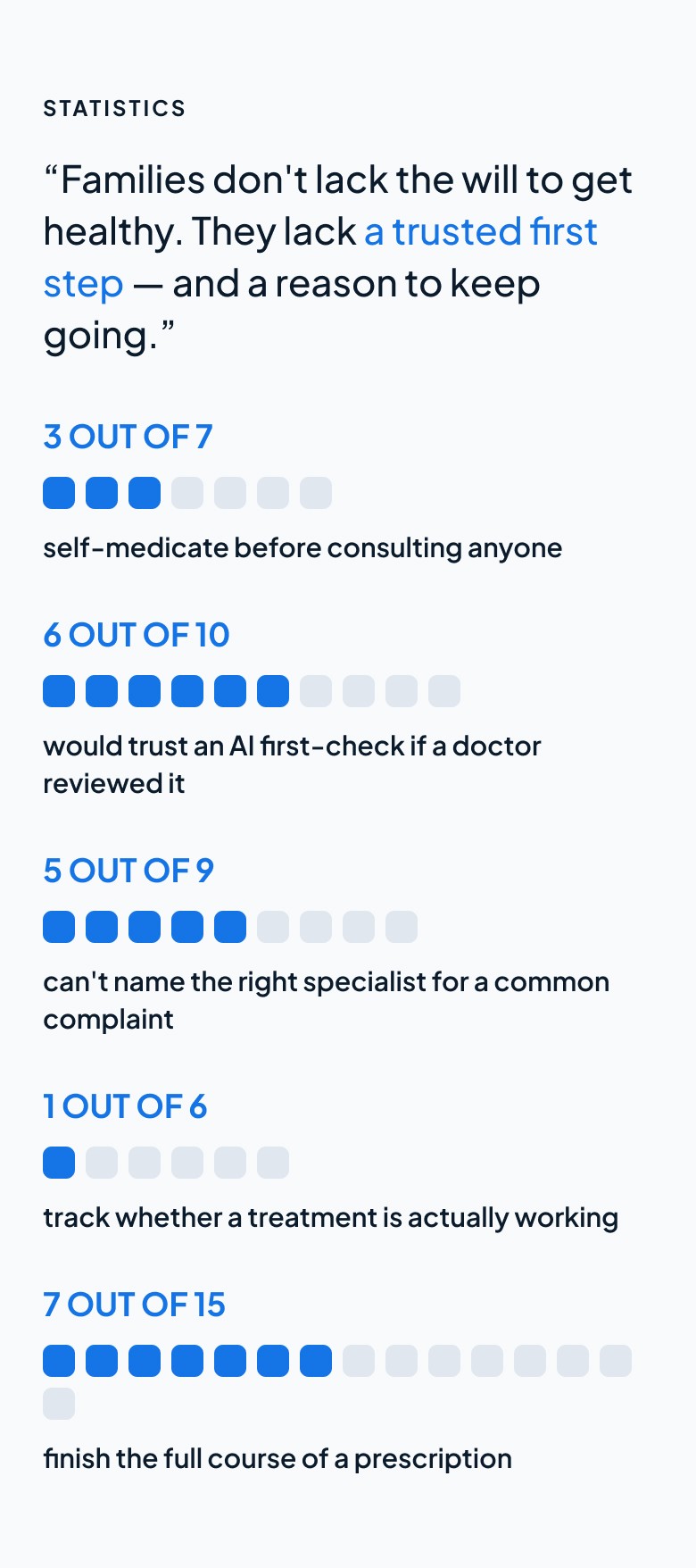
STATISTICS
“Families don't lack the will to get healthy.
They lack
a trusted first step
and a reason to keep going.”
3 OUT OF 7
self-medicate before consulting anyone
6 OUT OF 10
would trust an AI first-check if a doctor reviewed it
5 OUT OF 9
can't name the right specialist for a common complaint
1 OUT OF 6
track whether a treatment is actually working
7 OUT OF 15
finish the full course of a prescription they're given
MENTAL MODELS
A quick word-association test to reveal how families really approach their health.
Respondents picked the single word that best described their attitude to healthcare. We plotted each word by how engaged that mindset tends to be.
LEVEL OF ENGAGEMENT
Proactive
18%
Cooperative
14%
Cautious
26%
Reactive
19%
Overwhelmed
15%
Avoidant
8%
USER JOURNEY
How families navigate the current scenario

Symptom strikes at night
Aanya spikes a fever; Priya can't gauge how serious it is.
Frantic search
She Googles the symptoms — conflicting, alarming results.
Asks around
Pings family WhatsApp groups for second opinions.
Hunts for a doctor
Calls the clinic — a GP or a pediatrician? She's unsure.
Waits & travels
Takes leave and travels with a sick child to the next slot.
The rushed consult
The doctor explains fast; half is forgotten by the time she's home.
Meds & follow-up
Unclear on dosage, she misses a dose — and the fever returns.
Eventual recovery
Better — but only after stress, guesswork and a repeat visit.

PAIN POINTS
The problems faced along the way
“Is this serious?”
No trusted first read on symptoms — anxiety or dangerous delay.
Information overload
Conflicting online advice fuels fear, not clarity.
Wrong door
Unsure which specialist to see — wasted visits and repeat fees.
Access friction
Slots, travel and taking leave with a sick child.
Lost after the visit
Advice forgotten; no written, plain-language plan.
Dosage confusion
Unclear medication timing and quantity.
No feedback loop
Can't tell if treatment is working — until a relapse.
Analysis
Analysis
Analysis
USER PERSONAS
How many types of approaches exist toward everyday health?

1
Priya Menon
· 34
Ops lead in Pune, mother of Aanya (4). Time-poor, health-anxious, digitally fluent — the default first responder for the whole family.
SCENARIO
Active use of healthcare, high trust in doctors, moderate use of online tools. Wants reassurance fast and hates dropping the ball on anyone's care.
GOALS
Get a trustworthy first read on symptoms in seconds
Reach the right clinician without guesswork
Keep the whole family on track with meds & follow-ups

2
Rohan Shetty
· 27
First job, lives alone, tech-savvy. Only sees a doctor when it's already bad; low patience for process.
SCENARIO
Passive use of healthcare, high trust in the internet, low compliance due to time and low priority on health.
GOALS
Frictionless booking when he finally decides to act
Clear reminders to actually finish a course
On-demand answers without a clinic trip

3
Meera Iyer
· 41
Works at a biotech firm, mother of two. Assertive, preventive-minded, low trust in online sources — prefers to partner with a doctor.
SCENARIO
Passive but smart use of healthcare. Coordinates care across multiple hospitals for the family and favours a cautious, preventive approach.
GOALS
Coordinate records & history from different hospitals
Preventive nudges, not just sick-care
A simple, predictable booking journey

4
Anil Deshpande
· 63
Retired manager; relies on his daughter to coordinate visits. Not comfortable with apps, but highly compliant once told what to do.
SCENARIO
Active use of healthcare, low reliance on technology, content to let providers decide. High compliance but not independent.
GOALS
Regular check-ins that flag problems early
Someone in the family kept in the loop automatically
Documents & prescriptions stored safely in one place
“There is
no one-size-fits-all
path to health.”
Guided & dependent
Active & in the loop
Reluctant & reactive
Engaged & preventive
LEVEL OF ENGAGEMENT
TARGET AUDIENCE
Which group of people will this product focus on catering to?
Age group
0
18
60+
Level of engagement
Low
High
Need for care
Low
High
DEMOGRAPHY
Comfortable with smartphones, UPI and everyday apps
Between 18 and 60 years of age
Urban & semi-urban, lower-middle to upper class
INTENTIONS
Faster recovery and fewer recurring conditions
Caregiving for the whole family from one place
One trusted channel between them and their hospital
APPREHENSIONS
Being handed an algorithm with no doctor behind it
Post-visit confusion, forgotten advice, non-adherence
A purely transactional, book-and-forget health app
USER GOALS
“People want to
stay healthy for longer
the system should help them.”

Know fast if a symptom is minor or urgent

Reach the right clinician the first time

Understand and remember what to do next

Stick to the treatment plan
without nagging or guesswork

Avoid unnecessary repeat visits
resolve it in as few trips as possible

Keep the whole family's care in one place

Feel a real doctor stands behind the advice

Learn enough to make informed decisions
MARKET ANALYSIS
Several apps serve slices of the journey — but each solves only one part, and the handoffs between them are where families fall through.

Practo
Doctor discovery, bookings and online consults, plus a digital health record.

Tata 1mg
Online pharmacy, lab-test scheduling and e-consultations.

MFine / DocsApp
AI-assisted chat consultations with doctors, on demand.

Symptom checkers
Self-serve triage (Ada, WebMD) with no clinician or handoff to care.
Strengths
End-to-end loop from first symptom to recovery, in one place
Doctor-in-the-loop keeps AI advice trustworthy
Family accounts cover the whole household's care
Plain plans that actually get followed
Weaknesses
Depends on clinicians to review AI output
Trust must be earned over time
Clinical content is heavy to build and maintain
Behaviour change — not just a download — drives value
Opportunities
Own the confidence loop incumbents leave open
Regional languages unlock the next 100M users
Preventive nudges cut the long-term cost of care
Hospital partnerships hungry for engagement
Threats
Incumbents bolt AI triage onto existing apps
Regulation of AI in healthcare tightens
Clinician bandwidth to review at scale
Skepticism after past symptom-checker letdowns
Most players own one slice — discovery, pharmacy, or chat. None own the full arc from a worried first symptom to a completed recovery, with a clinician accountable throughout.
That gap — the confidence loop — is exactly where MedicAI is positioned, and why a doctor-in-the-loop AI is defensible where a pure chatbot is not.
NECESSITY
MedicAI strengthens the bond between patient, doctor and hospital with the same information available to everyone.
Patient engagement is when people are active participants in their care and valued decision-makers in it. Engaged patients are:
INFORMED
They understand their condition and the plan their doctor recommends.
HEARD
They're part of a two-way conversation and share in decisions.
EMPOWERED
They actively shape their own health and recovery.
By engaging patients in their own care, providers see real, measurable benefits including:

Reduced cost of care

Better health outcomes

Fewer admissions & readmissions

Higher patient retention
Ideate
Ideate
Ideate
KEY FEATURES
Solutions provided by the app to each problem and requirement.
PROBLEM
SOLUTION
Families can't tell if a symptom is serious.
An AI symptom co-pilot gives a triage read in seconds.
They don't know which specialist to see.
A guided finder routes them to the right doctor by symptom.
Conflicting online information fuels anxiety.
One calm, plain-language assessment with a clear next step.
Advice is forgotten by the time they're home.
A plain-language care plan is saved right in the app.
Doses get missed and courses stop early.
Smart reminders and adherence tracking keep it on course.
It's unclear whether treatment is actually working.
A symptom-based progress tracker vs. expected recovery.
Prescriptions are illegible and medicines unclear.
Structured meds with dosage, timing and purpose.
One person manages the whole family's health.
Family profiles give each member the same tools.
“Is an algorithm really safe to trust?”
A doctor reviews every AI recommendation — always.
KANO ANALYSIS
Prioritising features by the value they add for families.
BASIC FEATURES
AI symptom triage with a clear next step
Book the right doctor & get confirmation
Doctor-in-the-loop review of AI output
Medicine & appointment reminders
Digital records — labs, prescriptions, bills
Plain-language care plans
SATISFIERS
Body-map symptom intake
Right-specialist recommendation
Reschedule or cancel with ease
Lab upload with AI analysis
Family profiles & quick switching
Video & chat consultations
DELIGHTERS
Recovery progress vs. expected curve
SOS emergency dispatch
Health trends & insights over time
Proactive preventive nudges
Regional-language support
INFORMATION ARCHITECTURE
Navigation and flows through the product.
MedicAI
01 · Home / Feed
Mood check
Your Doctor
Reminders
Top specialists
02 · AI Co-pilot
Chat
Shortcuts
Ask-AI
03 · Symptom Checker
Intake
Body map
Follow-up Qs
AI assessment
Lab report
04 · Care & Booking
Find doctors
Specialists
Doctor detail
Payment
Confirmation
05 · Messages
Inbox
Chat thread
Video call
Schedule
06 · Health
Upload lab
AI analysis
Trends
Meds
Add medicine
07 · SOS
Confirm
Live dispatch
08 · Profile
Family
Saves
History
Payments
Privacy
Help
MedicAI User Flow
Onboarding
Splash
Get started
Sign in / sign up
AI permissions
Home hub
AI brief
Search
Quick actions
Bottom navigation
Primary actions
Ask AI
Check symptoms
Find and book doctor
Messages and video
Labs and trends
Medication tracker
Emergency SOS
Profile and privacy
MedicAI Settings
Profile
Entry from bottom nav. Account summary remains light; deeper tasks move into settings.
Settings hub
Routes user by intent: family, privacy, payment, history, saves, help, sign out.
Privacy & data
AI memory, voice, personalization, sharing, export/delete.
My family
Managed profiles for self, child, elder; separate records.
Payment methods
Cards, default payment, insurance, recent charges.
Medical history
AI summary, timeline, export record PDF.
My saves
Saved doctors, articles, care plans by tab.
Help & FAQs
Search, Ask AI, support, expandable FAQ.
Sign out
Protected exit with cancel and continuity note.
WIREFRAMES
Low-fidelity representations of the core flow.

Splash

Get Started
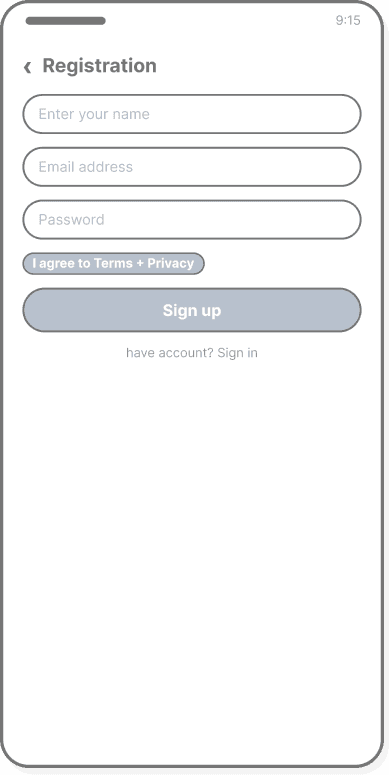
Sign up

Sign in

AI setup

Symptom intake

Home

AI co-pilot

Inbox

Body map

AI assessment
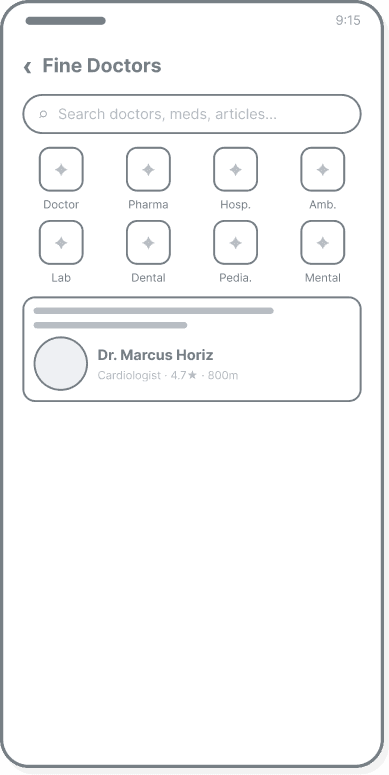
Find doctors

Specialists list

Doctor details

Payment confirm

Chat thread
Design
Design
Design
VISUAL LANGUAGE
TYPEFACE
Plus Jakarta Sans
A modern geometric sans — warm, legible and calm. It carries clinical clarity without feeling cold, and reads cleanly at the small sizes a health app demands.
ABCDEFGHIJKLMNOPQRSTUVWXYZ
abcdefghijklmnopqrstuvwxyz
0 1 2 3 4 5 6 7 8 9 & ? ! %
Aa
Aa
Aa
Aa
Aa
Aa
UI COLOURS
Ink
#0B1B2B
Body
#324155
Muted
#8A98AC
Surface
#FFFFFF
Primary
#1574E5
DENOTATIVE COLOURS
Positive · Trust
#1574E5
Success · Recovery
#1FA971
Alert · Urgent
#D8443C
APP ICON
The mark fuses three ideas — care, conversation and intelligence — into a single symbol: a medical cross that doubles as a chat prompt, signalling an AI you can talk to.
Care
Conversation
Intelligence
→
On light
On brand
GET STARTED
Onboarding
First-run introduces MedicAI in three calm screens — what it does and how a doctor stays involved. Sign-in is password-free, by mobile or social, so nothing stands between a worried parent and help.


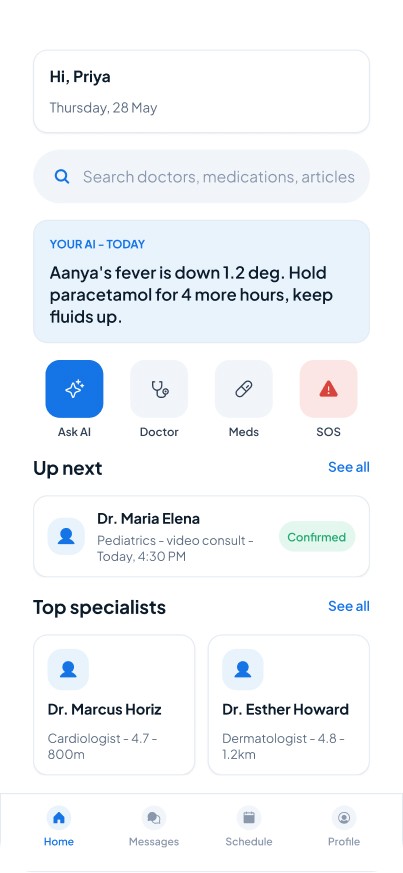

THE FEED
Home
The feed opens on a calm daily check-in — mood, an AI note for the day, what's next, and medicine reminders — so the whole household's health is one glance away.
ASK ANYTHING
AI Co-pilot
A conversational co-pilot answers health questions in plain language, suggests next steps, and hands off to a doctor when it matters — never a dead end, never advice it can't stand behind.


GUIDED TRIAGE
Symptom checker
A structured intake — plain-language questions, a tap-to-mark body map, and smart follow-ups — turns a vague worry into a clear, shareable picture the AI (and a doctor) can act on.


THE PAYOFF
AI assessment
The moment that earns trust: a calm, plain-language read with a clear next step — and a visible promise that a clinician stands behind it.
URGENCY
A clear low / medium / high read, in plain words.
WHAT I'D DO
Concrete, do-this-now steps — not medical jargon.
ESCALATION RULE
Exactly when to see a doctor. No ambiguity.
SAFETY
Always labelled ‘not a diagnosis’ — a clinician reviews it.


RIGHT CARE, FIRST TIME
Find doctors
No more guessing which specialist to see. MedicAI recommends the right kind of doctor for the symptoms, shows who's available and nearby, and books in a couple of taps.
CONFIRM & PAY
Booking
The last mile is frictionless: confirm the slot, pay in-app or at the hospital, and get an instant confirmation that lands in the feed and upcoming visits.


STAY CONNECTED
Messages
Families talk to their hospital directly — share a report, ask a follow-up, or jump on a video consult — with the clinic acting as the trusted bridge to the doctor.
MAKE SENSE OF RESULTS
Lab analysis
Snap or upload a lab report and MedicAI explains it in plain language — what's normal, what's worth a conversation — then routes anything concerning to a doctor.


THE FOLLOW-THROUGH
Health trends
Recovery becomes visible: symptom and vitals trends tracked against expected curves, plus medication reminders that keep the whole course on track.
WHEN IT'S URGENT
SOS
One tap dispatches help and shares location and key medical details with emergency contacts and the nearest hospital — the calm path for the scariest moments.


ONE ACCOUNT, WHOLE FAMILY
Profile
Every family member gets their own profile — history, medications and documents in one place — so one caregiver can manage everyone's health without juggling apps.
OUTCOMES
Early signals that the confidence loop actually works.
< 60s
Time to a first read
6–8 min of Googling → a guided answer in under a minute.
41% → 86%
Right specialist, first time
Task tests: choosing the correct doctor for a complaint.
11 / 12
Knew their next step
Completed the ‘what do I do now?’ task unaided.
+22%
Modeled follow-through
Projected adherence lift (directional pilot model).
REFLECTION
What this project taught me.
01
Trust is the feature
The doctor-in-the-loop mattered more than raw model accuracy. People forgave an imperfect answer when a clinician clearly stood behind it.
02
Plain language beat completeness
Every time I traded medical detail for one clear next step, comprehension and confidence went up. Less really was more.
03
Scope discipline won
Saying no to pharmacy, insurance and social features kept the core confidence loop sharp — and, crucially, shippable.
What's next: real clinical validation with a partner hospital, regional-language support, and a small monitored pilot to test the modeled follow-through gains.
Thank you
MedicAI is a self-initiated concept — an AI health co-pilot for Indian families, with a doctor always in the loop.
ROLE
Product Designer — research, UX, UI, prototype
TIMELINE
6-week self-initiated project
TOOLS
Figma · user interviews · survey
Sources: WHO physician-density data · KPMG ‘Healthcare in India’ · Deloitte patient-engagement research · primary survey.
Designed by Amandeep Rajput